Sunday, April 5, 2009

VIVISIMO DISECTING DAVOS PENULTIMATE AVIS REALITY

VIVISIMO DISECTING DAVOS PENULTIMATE AVIS REALITY

division of labor : Dividing a job into many specialized parts, with a single worker or a few workers assigned to each part. Division of labor is important to MASS PRODUCTION.

ethical relativism
: In ETHICS, the belief that nothing is objectively right or wrong, and that the definition of right or wrong depends on the prevailing view of a particular individual, CULTURE, or historical period.

judicial activism
: A THEORY of interpretation of the CONSTITUTION that holds that the spirit of the times, the values of the justices, and the needs of the nation may legitimately influence the decisions of a court, particularly the SUPREME COURT.

Positivism
: An approach to PHILOSOPHY frequently found in the twentieth century. Positivists usually hold that all meaningful statements must be either logical inferences or sense descriptions, and usually argue that the statements found in METAPHYSICS, such as ‹Human beings are freeŠ or ‹Human beings are not free,Š are meaningless because they cannot possibly be verified by the senses.

Primitivism
: A style of art that attempts to imitate the art of primitive CULTURES or of children.Relativism : The doctrine that no ideas or beliefs are universally true, but that all are instead ‹relativeŠ Ö that is, their validity depends on the circumstances in which they are applied.Vivisection : The cutting up or dissection of animals in scientific research. Vivisection is also a general term for the use of animals as subjects in laboratory experiments, especially in the development of new medical techniques and drugs.

The SculPTor

Saturday, April 4, 2009

F-8

FATES. According to the mythology of many ancient peoples, the gods spun the web of human destiny, or fate. In Greek mythology there were three goddesses called the Moirai. The Greek poet Hesiod, in his 'Theogony', wrote that they were the daughters of Zeus and Themis. In another passage he called them the daughters of Night.

Their names were Clotho (Spinner), who spun the thread of life; Lachesis (Disposer of Lots), who determined its length; and Atropos (Inflexible), who cut the thread. They had no will of their own but did what Creation told them to do; hence the word fate, from the Latin fatum, "that which is spoken."

In modern Greek folklore the Moirai appear on the third night after a child's birth and direct the course of its life. The Roman Fates, who corresponded to the Greek Moirai, were the Parcae (plural of Parca, the goddess of childbirth), or birth spirits. Their names were Nona, Decuma, and Morta. The French Fates were called Parques, after the Latin.

In German and Norse mythology the three Norns wove and spun the web of life. They were Urth, or Urd (the past); Verthandi, or Verdandi (the present); and Skuld (the Future). The Egyptians personified fate in the god Shai. The name was derived from the verb meaning to decide. The Chinese word for fate is ming, which means something spoken or decreed.
Bing, Being, Boeing, Beijing, Bang
______________________________________________________
The SculPTor (1776-1867)

WWW.WORDSCULPTOR.NET aka WWW.KEALEY.NET

Web Site of Glen Kealey, National PresidentCanadian Institute for Political Integrity (CIPI)

http://kealeyne.ipower.com

http://www.wordsculptor.net/web/previous/kealeynet/content/index4.html

UNTIL FURTHER NOTICE THIS WORDSCULPTORPOST IS BEING BLOCKED (censored) BY HOST

Ipower (Phoenix /via India) -- their server FIDO continuously dropsthe connection)

Son Day April 04, 2009
REGO ONTO APRIL 13 WINDOW -- APRIL FOOLS DAY TWO
(Persian Quean Esther's Mary Magdalene OLED Monday)

Jacques Lipchitz


June 27 - August 22, 2004

(above: (right: Jacques Lipchitz (American, born Lithuania, 1891-1973), Prometheus Strangling the Vulture, begun 1944, cast 1953-53, bronze, 96 1/2 x 92 inches. Purchased with the Lisa Norris Elkins Fund, 1952)

Selected from works found in collections in and around Philadelphia, the exhibition will explore the artist's momentous and colorful relationship with the city. Lipchitz's involvement with Philadelphia began in 1922, when Dr. Albert C. Barnes commissioned him to execute a group of stone bas-reliefs for Paul Cret's building for the Barnes Foundation in nearby Merion, Pa., and culminated in 1976, when his monumental sculpture Government of the People (1965-1976) sculpture was posthumously unveiled on Municipal Plaza opposite City Hall.

Jacques Lipchitz (1891-1973), one of the most acclaimed and innovative sculptors of the twentieth century, had a longstanding connection with Philadelphia, where his work can be seen in the Museum, opposite City Hall, along the Schuylkill River, as well as at The Barnes Foundation in Merion.

A Jewish immigrant from Lithuania, Lipchitz moved to Paris in 1909 and then to America in 1941. During the last three decades of his life, Lipchitz was a frequent visitor to Philadelphia, where he worked on two major public commissions, was twice honored for his sculpture by the Pennsylvania Academy of the Fine Arts, and had an important exhibition at the Philadelphia Museum of Art in 1964. Not surprisingly then, the Philadelphia Museum of Art owns one of the largest collections of Lipchitz's work outside of Israel. These holdings were further enriched by the recent gift of five sculptures by the Jacques and Yulla Lipchitz Foundation in honor of the Museum's 125th anniversary. (right: Jacques Lipchitz (American, born Lithuania, 1891-1973), Sailor with Guitar, 1914, bronze, 31 x 11 5/8 x 8 1/2 inches, Philadelphia Museum of Art: Gift of Mrs. Morris Wenger in memory of her husband, 1949)

Lipchitz is perhaps best known for the Cubist work he made in Paris in the 1910s, and the Museum owns several important examples, including Sailor with Guitar (1914) and Woman with Braid (1914), both conceived during a trip to Spain in the company of the Mexican painter Diego Rivera.

In the next decade, following the success of his Barnes Foundation commission in 1923, Lipchitz became the pre-eminent sculptor of the Cubist movement, receiving international recognition. In 1925, the heavy, angular forms, which had characterized Lipchitz's Cubist output, gave way to the more abstract forms of his openwork sculptures, inspired in part by the African art that he so passionately collected.

During and after the Second World War Lipchitz tried to give artistic expression to the turbulence and suffering of the preceding decade by modeling a number of mythological and biblical groups that are characterized by Baroque pathos and highly expressive gestures.

The Museum owns some outstanding examples of the artist's allegorical late work, including The Prayer (1943) and Prometheus Strangling the Vulture (1944-53). Beyond the Museum's walls, Lipchitz's The Spirit of Enterprise (1950-60) can be found on Kelly Drive, while the controversial Government of the People (1965-1976) dominates the Municipal Services Building Plaza opposite City Hall, where it looms over a realistic statue of Mayor Frank Rizzo who bitterly opposed its placement in Philadelphia. Supporters of this powerful symbol of democracy, led by R. Sturgis Ingersoll, eventually succeeded in having the work on public view in time for the nation's Bicentennial in 1976. (left: Jacques Lipchitz (American, born Lithuania, 1891-1973), Government of the People, c. 197, 32 x 18.5 inches. Gift of the city of Philadelphia)

This exhibition will trace the development of Lipchitz's art as represented in the Museum's holdings and selected objects from local area private collections, as well as some related works by other artists. Some 50 objects will be on view, including sculptures, drawings, prints and photographs.

"Philadelphia has long been an important destination for admirers of Jacques Lipchitz's innovative and powerful sculpture," said Anne d'Harnoncourt, Director of the Philadelphia Museum of Art. "Works from all periods of the artist's long and prolific career have an important presence inside and outside the Philadelphia Museum of Art, which owns one of the largest collections of Lipchitz's work outside of Israel. Our holdings were further enriched by the recent gift of five sculptures, four in plaster and one in terra cotta, by the Jacques and Yulla Lipchitz Foundation in honor of the Museum's 125th anniversary."

The Curator for the exhibition is Michael Taylor, Acting Head Curator, Modern and Contemporary Art

In conjunction with the exhibition, the Museum has produced a double issue of the Museum Bulletin (Publication date: July 2004). Focusing on an important but unexplored aspect of the artist's career that involved over five decades of work in Philadelphia, the Bulletin will include an essay by Michael Taylor. It discusses the Museum's holdings and the artist's ties to Philadelphia, with particular emphasis on his early support from Dr. Albert C. Barnes. Among the other topics examined in detail are Lipchitz's two important commissions for public sculpture for the City of Philadelphia, his numerous appearances on the What in the World? television program that was broadcast nationwide from the University of Pennsylvania in the 1950s and 1960s, and the Museum's major 1964 retrospective.

Following on the heels of the opening of Jacques Lipchitz and Philadelphia are two free family programs offered by the Philadelphia Museum of Art's Education Department, which will provide hands-on opportunities to follow in Lipchitz's artistic footsteps.

On Sunday, July 11, the Museum will offer Celebrate: Lipchitz, during which families will be able to see the works of Lipchitz as Klingon Klezmer provides festive Jewish music. Participating families will also be able to take a self-guided tour, create three-dimensional art in the galleries, and make Lipchitz-inspired sculptures to take home.

Families are also invited to Celebrate: Sculpture Sunday, August 8, and meet well-known Philadelphia sculptors and watch as they demonstrate how to create sculptures out of wood, clay and bronze. Families will also be able to learn about three-dimensional art through self-guided tours and the Museum's Draw Together program.

rev. 6/7/04

Europa

Europa left behind by the European bureaucrats

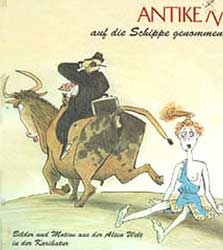
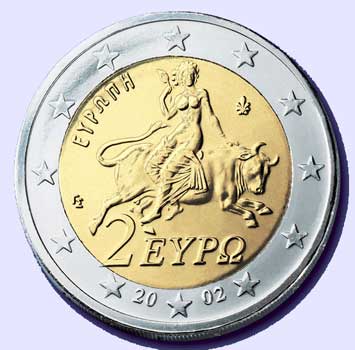
Europa (Greek Ευρωπη) was a Levantine woman in Greek mythology, from whom the name of the continent Europe was ultimately taken. There were two competing myths relating how Europa came into the Greek world: in the more familiar one she was seduced by the god Zeus in the form of a bull and carried away to Crete on his back, but according to Herodotus she was kidnapped by Minoans, who likewise were said to have taken her to Crete. The mythical Europa cannot be separated from the mythology of the sacred bull, which had been worshipped in the Levant. The etymology of her name (ευρυ- "wide" or "broad" + οπ- "eye(s)" or "face") suggests that Europa represented a cow, at least at some symbolic level.

Greek 2 Euro Coin, Zeus and Europa, European Central Bank

According to legend, Zeus was enamored of her and decided to seduce or rape her, the two being near-equivalent in Greek myth. He transformed himself into a white bull (or possessed one) and mixed in with her father's herds. While Europa and her female attendants were gathering flowers, she saw the bull and caressed his flanks and eventually got onto its back. Zeus took that chance and ran to the sea and swam, with her on his back, to the island of Crete. He then revealed his true identity and Europa became the first queen of Crete. Zeus gave her three gifts: Talos, Laelaps and a javelin that never missed. Zeus later re-created the shape of the white bull in the stars which is now known as the constellation Taurus. Some legends relate that this same bull was also encountered by Hercules, and that it eventually fathered the Minotaur.

Europa's family

Sources differ in details regarding her family but agree that she is Phoenician, and from a lineage that descended from Io, the mythical princess who was transformed into a heifer. Most commonly, she is said to be the daughter of the Phoenician King Agenor and Queen Telephassa of Tyre. Other sources, such as the Iliad, claim that she is the daughter of Agenor's son, Phoenix. It is generally agreed that she had two brothers, Cadmus, who brought the alphabet to mainland Greece, and Cilix who gave his name to Cilicia in Asia Minor. After arriving in Crete, Europa had three children: Minos, Rhadamanthus, and Sarpedon. She married Asterion; and then later, Asterius. According to mythology, her children were fathered by Zeus.

Europa in literature

Ovid

The poet Ovid wrote the following depiction of Zeus' seduction:

Europa in a fresco at Pompeii contemporary with Ovid
And gradually she lost her fear, and he
Offered his breast for her virgin caresses,
His horns for her to wind with chains of flowers
Until the princess dared to mount his back
Her pet bull's back, unwitting whom she rode.
Then—slowly, slowly down the broad, dry beach—
First in the shallow waves the great god set
His spurious hooves, then sauntered further out
Till in the open sea he bore his prize
Fear filled her heart as, gazing back, she saw
The fast receding sands. Her right hand grasped
A horn, the other lent upon his back
Her fluttering tunic floated in the breeze.

His picturesque details belong to anecdote and fable: in all the depictions, whether she straddles the bull, as in archaic vase-paintings or the ruined metope fragment from Sikyon, or sits gracefully sidesaddle in a mosaic from North Africa, there is no trace of fear. Often Europa steadies herself by touching one of the bull's horns, acquiescing.

Herodotus

According to Herodotus, Europa was kidnapped by Minoans who were seeking to avenge the kidnapping of Io, a princess from Argos. His variant story may have been an attempt to rationalize the earlier myth.

Europa in the visual arts

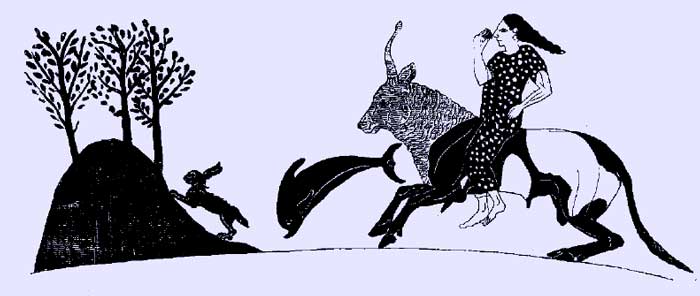
Greek vase paintings
Roman frescoes (see image above)
François Boucher, The Rape of Europa
Gustave Moreau, Europa and the Bull (see image above)
Titian, The Rape of Europa
Paolo Veronese, The Rape of Europa

Europa as the continent's name

The continent of Europe is called Europa in all Germanic languages except English, Hungarian (Európa) and in all Slavic languages that use the Latin alphabet, as well as in Greek and Latin. Her name appeared on postage stamps commemorating the "United Europe", which were first issued in 1956.

Music

Helge Jörns (1941) Europa und der Stier (Oper in einem Bild)

Europa and Zeus, Hydria , Louvre Museum

Stamps

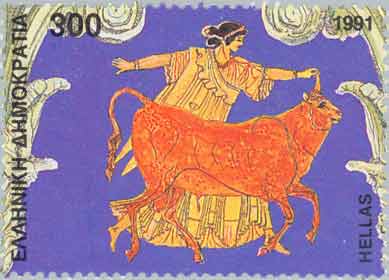
Europa Mythology,

Jupiter moon Europa

Asteroid 52 Europa

References

Apollodorus, Bibliotheke, III, i, 1-2

Herodotus, The Histories, Book 1.2

Ovid, Metamorphoses, 862, translation by A.D. Melville (1986), p.50

Links

A metope from Sicily, carved with Europa, ca 550 - 540 BC the bull's face, turned head-on, clearly reveals his Near Eastern iconic antecedents


Mythology Images

Retrieved from "http://en.wikipedia.org/"
All text is available under the terms of the GNU Free Documentation License

DAVOS SWITZERLAND AXIS


The World Economic and Social Forums :

A SIMA~SIAL international ShapeShifting (SS) organization reportedly committed to improving the state of the world.

The Forums provide a collaborative framework for the world's SS leaders to address current global issues, engaging particularly its transnational corporate members in global New World Order (NEW SS ATLANTIS) citizenship.

SEESAW : Lipchitz, Jacques. 1891-1973. Russian-born French sculptor who was associated with the cubists. His works include Rape of Europa (1941) and Prayer (1943).
The SculPTor

Friday, April 3, 2009

Davos

Davos
Country Switzerland Coat of Arms of Davos
Canton Graubünden
District Prättigau/Davos
46°48′N 9°50′E / 46.8°N 9.833°E / 46.8; 9.833Coordinates: 46°48′N 9°50′E / 46.8°N 9.833°E / 46.8; 9.833
Population 10,744 (December 2006)
- Density 42 /km² (109 /sq.mi.)
Area 254.48 km² (98.3 sq mi)
Elevation 1,560 m (5,118 ft)
Davos - Top left: Weissfluhjoch, Top right: World Economic Forum congress centre, Bottom: View over Davos and the Parsenn ski area by night
Top left: Weissfluhjoch, Top right: World Economic Forum congress centre, Bottom: View over Davos and the Parsenn ski area by night
Postal code 7260 Davos-Dorf
7270 Davos-Platz
SFOS number 3851
Surrounded by Arosa, Bergün/Bravuogn, Klosters-Serneus, Langwies, S-chanf, Susch, Wiesen
Twin towns Aspen (USA), Sanada (Japan), Chamonix (France)
Website www.gemeinde-davos.ch
SFSO statistics
Davos is located in Switzerland
Davos
Davos

Davos (Romansh: Tavau, Italian: Tavate) is a municipality in the district of Prättigau/Davos in the canton of Graubünden, Switzerland.

It is located on the Landwasser River, in the Swiss Alps, between the Plessur and Albula Range.

Davos is famous as the host to the World Economic Forum (WEF), an annual meeting of global political and business elites, which is often referred to as simply Davos. It is also known as a winter sports area, including serving as the site of the annual Spengler Cup ice hockey tournament, which is hosted by the HC Davos local hockey team.

Davos is the largest ski resort in Switzerland and the highest city in Europe.[1]

History

The current settlement of the Davos area started back in High Middle Ages with the immigration of Rhaeto-Romans. Then from about 1280 the barons of Vaz allowed Walser (German speaking) colonists to settle down and conceded them extensive self-administration rights Davos became the largest Walser settlement area in eastern Switzerland Natives therefore still speak. In the "natural ice" era of winter sports, Davos, and the Davos Eisstadion was a mecca for speed skating. Many international championships were held here, and many world records were set, beginning with Peder Østlund who set four records in 1898. A dialect that may seem a typical for Graubünden, rather showing similarities with (German) idioms of western parts of Switzerland is spoken, such as in Bernese Oberland and the Upper Valais 1436, the League of the Ten Jurisdictions was founded in Davos from the middle of the 18th century, Davos became a popular destination for the rich and ailing because the microclimate in the high valley was deemed excellent by doctors and recommended for lung disease patients. For example Robert Louis Stevenson, who suffered from tuberculosis, wintered in Davos in 1880 at the recommendation of his Edinburgh doctor, Dr. George Balfour. Arthur Conan Doyle wrote an article about skiing in Davos in 1899. Davos is also the setting of Thomas Mann's novel Der Zauberberg (The Magic Mountain), which takes place at a sanatorium.

Subsequently, Davos became a famous ski resort, especially with tourists from the United Kingdom and The Netherlands. After a high peak in the 1970s and 1980s, the two-part city finally re-established itself as a leading, and less high-profile, tourist attraction.

The six main ski areas are:

Pronunciation

Park on the Promenade
Kirchner Museum

English-speaking broadcast journalists covering the World Economic Forum's Annual Meeting, along with many speakers at the meeting itself, commonly pronounce the town's name by emphasizing the first syllable and shortening the o to make the word rhyme with "moss", i.e., DAH-voss ([ˈdaː·vɔs]). The local pronunciation is dah-VOHS ([da'voːs]).

See also

HANDICAPPED WITH ZOROASTER'S HANDY CAP!

ZARATHUSTRA


The U.S.A. is an illusion of power fabricated to exist temporarily by Freemasonry; first, by means of the sponsorship of England's Masonic Royal Societies, and then, Germany's Pilgrims looking for Zion, the so called Celestial City (see John Bunyan's "The Pilgrim's Progress")

In fact, there is no such place as Zion. The Pilgrims were bamboozled. Zion is not a place, it is a "state of mind".

Zion is a condition which requires that "client of progress" wear a "handy cap" to symbolically cover up the mental handicap resulting from its implementation. Just look at the Pope, priests, etc. The purpose of Zion is to "progressively" engineer humans (ZOION),by dumbing them down (using operant conditioning) until partially brain dead end product "BEYONDMAN" (Ubermensch) evolves; as stated by the German author Fried Wilhelm (Will-I-Am) Nietzche, in his world famous 1883-92 Zoro-Astrian Freemasonic book titled "Thus Spake Zarathustra".

"BEYONDMAN" is an ideal superior man, a hermaphrodite who, according to Nietzsche, forgoes transient pleasure, exercises creative power, lives at a level of experience beyond standards of good and evil, and is the goal of human evolution. He is also called Overman. Beyondman symbolizes the theory that, apparently "The end justifies the means".

HERE IS HOW THE DICTIONARY DESCRIBES THESE ITEMS:


Nie.tzsche Friedrich Wilhelm. 1844-1990.

German philosopher who reasoned that Christianity's emphasis on the afterlife makes its believers less able to cope with earthly life. he argued that the ideal being, Ubermensch, would be able to channel passions creatively instead of suppressing them. His written works include Beyond Good and Evil (1886) and Thus Spake Zarathustra (1883-1892). -Nie'tzsche.an adj.n.

Thus Spake Zarathustra (WORLD LITERATURE,PHILOSOPHY, AND RELIGION)

A book of philosophical reflections by Friedrich Nietzsche, written in the style of a sacred book.
USA GE NOTES: Thus Spake Zarathustra puts forth Nietzsche's idea of the Superman, or Overman.


superman

n. 1. A man with more than human powers. 2. An ideal superior man who, according to Nietzsche, forgoes transient pleasure, exercises creative power, lives at a level of experience beyond standards of good and evil, and is the goal of human evolution. In this sense, also called overman. [Translation of German Ubermensch:uber-, super-+ Mensch,man.]

WORD HISTORY: Overman and Beyondman hardly seem likely names for a superhero, but perhaps Overman might be "leaping tall buildings at a single bound" had the German word Obermensch been translated differently than it was. However, Nietzsche's term for the ideal superior man was translated into English as superman, first recorded in a work by George Bernard Shaw published in 1903. Such a term comes to us through a process called loan translation, calque formation, whereby the semantic components of a word or phrase in one language are literally translated into their equivalents in another language, German Obermensch, made up iiber,"super-," and Mensch "man", thus becoming superman. Because iiber- can also be translated "beyond" and "over", we also find overman and beyondman as calques for the word Obermensch, but they did not take root. Shaw, in a letter written before 1917, noted that "some of our most felicitous writers. ..had been using such desperate and unspeakable forms as Beyondman, when the glib Superman was staring them in the face all the time." Hence, when it came to naming a new comic strip hero, Superman was the logical choice, a name first recorded in 1938.

yonder

adv. In or at that indicated distance, usually within sight: "Yonder hills," he said, pointing.pron. One that is at an indicated place, usually within sight. (Middle English, fromyond, yond. See YOND.]

REGIONAL NOTE: The adverb yonder, from Old English geond, is not exclusively Southern but is more frequently used there than in any other region of the United States, and not only by older or uneducated speakers. Yonder is not merely a Southern synonym for there, which in the South tends to mean "only a few feet from the speaker." Yonder carries with it an inherent sense of distance farther than "there" and is used if the person or thing indicated can be seen at all: the shed over yonder. Or it might be nearby but completely out of sight, as in the next room.


HER-IT-AGE

The Kealey Paper *Issue 22-4* February 2002 to July 2002

Thursday, April 2, 2009

The War Against BAD THINGS

PLACE: A city street in your town, USA.

TIME: The not too distant future.

FBI: Are you A. Citizen?

CITIZEN: Yes I am.

FBI: Come with us, you're under arrest.

CITIZEN: On what charge?

FBI: We don't have to tell you that.

CITIZEN: I want to call my lawyer.

FBI: We won't let you do that.

CITIZEN: You have to, it's my right!

FBI: You don't have any rights.

CITIZEN: Sez Who?

FBI: Sez the President. He's decided that you are an "enemy combatant" and as such you are not entitled to any Constitutional rights.

CITIZEN: BUT I haven't done anything.

FBI: The President will be the judge of that. In fact he's already made the decision. Besides, it's not what you've done, it's we think you were going to do.

CITIZEN: Based on what evidence?

FBI: We can't show you the evidence. It's classified.

CITIZEN: How can I defend myself at my trial if you won't tell me want the evidence against me is?

FBI: You get a trial. You're an enemy combatant, remember? We don't even have to charge you with anything. But in about a month, we'll hold a press conference telling everybody what we think you were up to, and that they can all sleep soundly because we've got you safely under lock and key and we intend to keep you there until the war is over.

CITIZEN: What war?

FBI: The War Against Bad Things.

CITIZEN: When will this war be over?

FBI: When we've eliminated all the bad things in the world.

CITIZEN: But that will never happen!

FBI: Now you're getting the idea.

CITIZEN: So let me get this straight. You're arresting me for something I haven't even done yet. You won't tell me what I'm charged with or what evidence you have against me. I don't get to talk to a lawyer. I don't get a trial . I don't have any opportunity to refute the charges or defend myself against them. You're just going to strip me of my Constitutional rights and lock me up for what amounts to a life sentence based on the whim of the President?

FBI: Is this a great country or what? God Bless America!

You are Z010N - but Zoro - Astrian Freemasons want Zion

You are ZOION, an independently moving organic unit, an animal, developed from a fertilized egg whose binary code (01) may be allowed to evolve naturally, or, be made to regress (10). This dumbing down process is called "human engineering".

The timetable for this Zoro - Astrian "business plan" is measured according to their calendar, The Zodiac. It represents a band of the celestial sphere about 8 degrees to either side of the ecliptic that represents the path of the principal planets, the moon, and the sun.

See Zoic/Zoon in your dictionary: zoion, living being.

1. An animal developed from a fertilized egg. 2. One of the distinct individuals that join to form a compound or colonial animal; a zooid; zooned, zoo.ing,zoons. To fly with a humming or buzzing sound. [Probably imitative.]

In symbolism a bumble-bee is represented as a "fleur-de-lys" - the emblem of France.

Ultimate Reality

Everyone is welcome, but only if they agree to supervise themselves.


FREEMASONRY is a SYSTEM of MORALITY (Religion)
veiled in ALLEGORY and
ILLUSTRATED by SYMBOLS
The English Language is their Master's Peace


"Morality is that instinctive sense of right and wrong that tells some people how everyone else should behave." Freemasons are Administrators of Chaos!