Monday, July 28, 2008
Mad scientists (transhumanism)
starring Dr. Kevin Warwick, Hugo de Garis PhD, and little old me. music by Populutionworks: http://www.populutionworks.com
So, you say you aren't worried about transhumanism? Listen to Aldous Huxley speak at Berkely at this link: http://cuttingthroughthematrix.com/ar...


Thursday, July 24, 2008
Don't fall for it


 Don’t fall for the rhetoric. Don’t follow individuals put up there and paid very well to be your leaders—the official opposition.
People should demand to know what oaths anyone who takes a paycheck from the taxpayer, what oaths they’ve taken to what societies. It should be on public record for everybody to see and published. All you have to do is vote in this so-called democratic system. Once you vote, that’s it. YOU HAVE NO MORE RIGHTS. You’ve just voted someone in without finding all about them because you heard all you wanted to hear. "I’m a this. I’m a conservative. I’m Republican. I’m left wing. I’m right wing. I’m this and that," and you’ve never asked the most important thing of all.
To what societies do you belong? What oaths have you taken?”
You give all this power to people who then you elect into office because they’re left wing, right wing or whatever, and they put laws over on you and you’re all standing back and saying why would he do that?
Because you didn’t ask him what he belonged to and you didn’t demand to know.
You didn't demand to know. It’s the same in every country.
Wednesday, July 23, 2008
Vaccines and Autism - The science and the politics
Wednesday, July 23rd, 2008
Discuss this report in the RINF forums >
Discuss this report in the RINF forums >
Children of the current generation receive 24 mandatory vaccinations. A generation ago, only 10 were required.
Through vaccinations, children receive 400x the amount of mercury deemed safe by the FDA.
The Hep B routinely given to newborns contains so much mercury preservative that it would normally only be considered safe under standard medical guidelines to give to a 275 pound adult.
Why is this going on?
Politics and corruption.
In the White House, in Congress, in the FDA, in the medical establishment and in the pharmaceutical industry.
Simple guidelines:
1. Never bring your child to be immunized if he or she is already ill
2. Do not allow the doctor to load your child up on multiple immunizations on a single visit just because it is more convenient for him, the doctor.
3. Avoid all unnecessary vaccinations. Make the doctor explain to you in detail the justification for every single one she recommends. They research it before you go ahead.
4. If you feel you must comply, delay them as long as possible to give your child time to grow
Civilization! - *Some Restrictions Apply
What is civilization?
 If some people hear that people want to “end civilization” they automatically respond in various negative ways because of their positive associations with the word “civilization.” This piece is an attempt to clarify, define and describe what I (and many others) mean by “civilization..”
If I look in the dictionary to find out what the commonly used definition of civilization is, here's what it says:
civilization
1: a society in an advanced state of social development (e.g., with complex legal and political and religious organizations); "the people slowly progressed from barbarism to civilization" [syn: civilisation]
2: the social process whereby societies achieve civilization [syn: civilisation]
3: a particular society at a particular time and place; "early Mayan civilization" [syn: culture, civilisation]
4: the quality of excellence in thought and manners and taste; "a man of intellectual refinement"; "he is remembered for his generosity and civilization" [syn: refinement, civilisation] [i]
The synonyms include "advancement, breeding, civility, cultivation, culture, development, edification, education, elevation, enlightenment, illumination, polish, progress" and "refinement.."
It goes without saying that the writers of dictionaries are "civilized" people - it certainly helps explain why they define themselves in such glowing terms.
As Derrick Jensen asks, "can you imagine writers of dictionaries willingly classifying themselves as members of 'a low, undeveloped, or backward state of human society'?" [1]
In contrast, the antonyms of "civilization" include: "barbarism, savagery, wilderness, wildness." These are the words that civilized people use to refer to those they view as being outside of civilization - in particular, indigenous peoples. "Barbarous", as in "barbarian", comes from a Greek word, meaning "non-Greek, foreign." The word "savage" comes from the Latin "silvaticus" meaning "of the woods.
" The origins seem harmless enough, but it's very instructive to see how civilized people have used these words:
barbarity
1: the quality of being shockingly cruel and inhumane [syn: atrocity, atrociousness, barbarousness, heinousness]
2: a brutal barbarous savage act [syn: brutality, barbarism, savagery] [ii]
savagery
1. The quality or condition of being savage.
2 .An act of violent cruelty.
3.
Savage behavior or nature; barbarity.. [iii]
These associations of cruelty with the uncivilized are, however, in glaring opposition to the historical record of interactions between civilized and indigenous peoples..
For example, let us take one of the most famous examples of "contact" between civilized and indigenous peoples. When Christopher Columbus first arrived in the "Americas" he noted that he was impressed by the indigenous peoples, writing in his journal that they had a "naked innocence. ... They are very gentle without knowing what evil is, without killing, without stealing.."
 And so he decided "they will make excellent servants.."
In 1493, with the permission of the Spanish Crown, he appointed himself "viceroy and governor" of the Caribbean and the Americas. He installed himself on the island now divided between Haiti and the Dominican republic and began to systematically enslave and exterminate the indigenous population. (The Taino population of the island was not civilized, in contrast to the civilized Inca who the conquistadors also invaded in Central America.) Within three years he had managed to reduce the indigenous population from 8 million to 3 million. By 1514 only 22,000 of the indigenous population remained, and after 1542 they were considered extinct.. [2]
The tribute system, instituted by [Columbus] sometime in 1495, was a simple and brutal way of fulfilling the Spanish lust for gold while acknowledging the Spanish distaste for labor. Every Taino over the age of fourteen had to supply the rulers with a hawk's bell of gold every three months (or, in gold-deficient areas, twenty-five pounds of spun cotton; those who did were given a token to wear around their necks as proof that they had made their payment; those did not were . "punished" - by having their hands cut off . and [being] left to bleed to death.. [3]
 More than 10,000 people were killed this way during Columbus' time as governor. On countless occasions, these civilized invaders engaged in torture, rape, and massacres.
On another occasion:
A Spaniard . . . suddenly drew his sword. Then the whole hundred drew theirs and began to rip open the bellies, to cut and kill - men, women, children and old folk, all of whom were seated off guard and frightened . . . And within two credos, not a man of them there remains alive. The Spaniards enter the large house nearby, for this was happening at its door, and in the same way, with cuts and stabs, began to kill as many as were found there, so that a stream of blood was running, as if a number of cows had perished.. [5]

This pattern of one-way, unprovoked, inexcusable cruelty and viciousness occurred in countless interactions between civilized and indigenous people through history..
This phenomena is well-documented in excellent books including Ward Churchill's A Little Matter of Genocide: Holocaust and Denial in the Americas, 1492 to the Present, Kirkpatrick Sale's The Conquest of Paradise: Christopher Columbus and the Columbian Legacy, and Dee Brown's Bury My Heart at Wounded Knee: An Indian History of the American West.
Farley Mowat's books, especially Walking on the Land, The Deer People, and The Desperate People document this as well with an emphasis on the northern and arctic regions of North America.
There is also good information in Howard Zinn's A People's History of the United States: 1492-Present and Voices of a People's History of the United States.
Eduardo Galeando's incredible Memory of Fire trilogy covers this topic as well, with an emphasis on Latin America (this epic trilogy as reviews numerous related injustices and revolts). Jack D.
Forbes' book Columbus and Other Cannibals: The Wétiko Disease of Exploitation, Imperialism and Terrorism is highly recommended.
You can also find information in Jared Diamond's Guns, Germs and Steel: The Fates of Human Societies, although I often disagree with the author's premises and approach..
The same kind of attacks civilized people committed against indigenous peoples were also consistently perpetrated against non-human animal and plant species, who were wiped out (often deliberately) even when civilized people didn't need them for food; simply as blood-sport.
For futher readings on this, check out great books like Farley Mowat's extensive and crushing Sea of Slaughter, or Clive Ponting's A Green History of the World: The Environment and the Collapse of Great Civilizations (which also examines precivilized history and European colonialism)..
 With this history of atrocity in mind, we should (if we haven't already) cease using the propaganda definitions of civilized as "good" and uncivilized as "bad" and seek a more accurate and useful definition. Anthropologists and other thinkers have come up with a number of somewhat less biased definitions of civilization..
Nineteenth century English anthropologist E.B. Tylor defined civilization as life in cities that is organized by government and facilitated by scribes (which means the use of writing). In these societies, he noted, there is a resource "surplus", which can be traded or taken (though war or exploitation) which allows for specialization in the cities..
The wonderful contemporary writer and activist Derrick Jensen, having recognized the serious flaws in the popular, dictionary definition of civilization, writes:
Jensen also observes that because cities need to import these necessities of life and to grow, they must also create systems for the perpetual centralization of resources, yielding "an increasing region of unsustainability surrounded by an increasingly exploited countryside.."
Contemporary anthropologist John H. Bodley writes: "The principle function of civilization is to organize overlapping social networks of ideological, political, economic, and military power that differentially benefit privileged households.." [7] In other words, in civilization institutions like churches, corporations and militaries exist and are used to funnel resources and power to the rulers and the elite..
The twentieth century historian and sociologist Lewis Mumford wrote one of my favourite and most cutting and succinct definitions of civilization.
Taking various anthropological and historical definitions into account, we can come up with some common properties of civilizations (as opposed to indigenous groups)..
* People live in permanent settlements, and a significant number of them in cities..
* The society depends on large-scale agriculture (which is needed to support dense, non-food-growing urban populations)..
* The society has rulers and some form of "aristocracy" with centralized political, economic, and military power, who exist by exploiting the mass of people..
* The elite (and possibly others) use writing and numbers to keep track of commodities, the spoils of war, and so on..
* There is slavery and forced labour either by the direct use of physical violence, or by economic coercion and violence (through which people are systematically deprived of choices outside the wage economy)..
* There are large armies and institutionalized warfare..
* Production is mechanized, either through physical machines or the use of humans as though they were machines (this point will be expanded on in other writings here soon)..
* Large, complex institutions exist to mediate and control the behaviour of people, through as their learning and worldview (schools and churches), as well as their relationships with each other, with the unknown, and with the nature world (churches and organized religion)..
Anthropologist Stanley Diamond recognized the common thread in all of these attributes when he wrote; "Civilization originates in conquest abroad and repression at home.." [9]
This common thread is control. Civilization is a culture of control. In civilizations, a small group of people controls a large group of people through the institutions of civilization. If they are beyond the frontier of that civilization, then that control will come in the form of armies and missionaries (be they religious or technical specialists). If the people to be controlled are inside of the cities, inside of civilization, then the control may come through domestic militaries (i.e., police). However, it is likely cheaper and less overtly violent to condition of certain types of behaviour through religion, schools or media, and related means, than through the use of outright force (which requires a substantial investment in weapons, surveillance and labour)..
That works very effectively in combination with economic and agricultural control. If you control the supply of food and other essentials of life, people have to do what you say or they die. People inside of cities inherently depend on food systems controlled by the rulers to survive, since the (commonly accepted) definition of a city is that the population dense enough to require the importation of food..
For a higher degree of control, rulers have combined control of food and agriculture with conditioning that reinforces their supremacy. In the dominant, capitalist society, the rich control the supply of food and essentials, and the content of the media and the schools. The schools and workplaces act as a selection process: those who demonstrate their ability to cooperate with those in power by behaving properly and doing what they're told at work and school have access to higher paying jobs involving less labour. Those who cannot or will not do what they're told are excluded from easy access to food and essentials (by having access only to menial jobs), and must work very hard to survive, or become poor and/or homeless. People higher on this hierarchy are mostly spared the economic and physical violence imposed on those lower on the hierarchy. A highly rationalized system of exploitation like this helps to increase the efficiency of the system by reducing the chance of resistance or outright rebellion of the populace..
 The media's propaganda systems have most people convinced that this system is somehow "natural" or "necessary" - but of course, it is both completely artificial and a direct result of the actions of those in power (and the inactions of those who believe that they benefit from it, or are prevented from acting through violence or the threat of violence)..
In contradiction to the idea that the dominant culture's way of living is "natural", human beings lived as small, ecological, participatory, equitable groups for more than 99% of human history.
There are a number of excellent books and articles comparing indigenous societies to civilization:
Chellis Glendinning's My name is Chellis and I'm in recovery from western civilization is an amazing and readable book, and it's one of my favourites. You can also read an excerpt of the chapter "A Lesson in Earth Civics" online.
See http://www. eco-action. org/dt/civics. html.
She has also written several related books, including When Technology Wounds: The Human Consequences of Progress..
John Zerzan's Against Civilization: Readings and Reflections composed of excerpts from the works of a wide range of authors..
The Culture of Make Believe by Derrick Jensen chronicles the violent hatreds that have been overwhelming our planet, tracing them back through their sources in imperialism, slavery, the rise of global capitalism, and the ideologies of possessiveness and consumerism..
Marshall Sahlin's Stone Age Economics is a detailed classic in that same vein.
You can read his essay "The Original Affluent Society" online at numerous places, including: http://www. primitivism. com/original-affluent. htm
Anthropologist Stanley Diamond's book In Search of the Primitive: A Critique of Civilization is another great classic..
Richard Heinberg's essay "The Primitivist Critique of Civilization" is also highly readable, and available online in many places including http://www. eco-action. org/dt/critique. html
There are also some good general websites with related writings, excerpts and articles.
Check out Radical Anthropology at http://www. radicalanthropology. com/writings. htm, Primitivism. com, Dead Trees EF! Online Publishing (http://eco-action. org/dt/index. html), and the essays at Earth Crash Earth Spirit (http://eces. org/)..
What these sources show is there were healthy, equitable and ecological communities in the past, and that they were the norm for countless generations. It is civilization that is monstrous and aberrant..
Living inside of the controlling environment of civilization is an inherently traumatic experience, although the degree of trauma varies with personal circumstance and the amounts of privilege different people have in society.
Derrick Jensen makes this point very well in his incredible book A Language Older than Words, and Chellis Glendinning covers it as well in My name is Chellis..
The inherent ecological unsustainability of civilization is another important point. That issue will be expanded on in writings here, in particular in the writings on the city and industry..
Related: See Ran Prieur's Critique
of Civilization FAQ for related information and critiques.
[1] Jensen, Derrick, Unpublished manuscript..
[2] I owe many of the sources in this section to the research of Ward Churchill. The figure of 8 million is from chapter 6 of Essays in Population History, Vol.I by Sherburn F. Cook and Woodrow Borah (Berkeley: University of California Press, 1971). The figure of 3 million is from is from a survey at the time by Bartolomé de Las Casas covered in J.B. Thatcher, Christopher Columbus, 2 vols. (New York: Putnam's, 1903-1904) Vol. 2, p. 384ff. They were considered extinct by the Spanish census at the time, which is summarized in Lewis Hanke's The Spanish Struggle for Justice in the Conquest of America (Philapelphia: University of Pennsylvania Press, 1947) p. 200ff.
This is too brilliant!!
Had to repost with the vid
Thanks
gwap
Thank you also
nilskidoo
KOYAANISQATSI
What is civilization?
..
If some people hear that people want to “end civilization” they automatically respond in various negative ways because of their positive associations with the word “civilization.” This piece is an attempt to clarify, define and describe what I (and many others) mean by “civilization..”
If I look in the dictionary to find out what the commonly used definition of civilization is, here's what it says:
civilization
1: a society in an advanced state of social development (e.g.
, with complex legal and political and religious organizations); "the people slowly progressed from barbarism to civilization" [syn: civilisation]
2: the social process whereby societies achieve civilization [syn: civilisation]
3: a particular society at a particular time and place; "early Mayan civilization" [syn: culture, civilisation]
4: the quality of excellence in thought and manners and taste; "a man of intellectual refinement"; "he is remembered for his generosity and civilization" [syn: refinement, civilisation] [i]
The synonyms include "advancement, breeding, civility, cultivation, culture, development, edification, education, elevation, enlightenment, illumination, polish, progress" and "refinement.."
It goes without saying that the writers of dictionaries are "civilized" people - it certainly helps explain why they define themselves in such glowing terms.
As Derrick Jensen asks, "can you imagine writers of dictionaries willingly classifying themselves as members of 'a low, undeveloped, or backward state of human society'?" [1]
In contrast, the antonyms of "civilization" include: "barbarism, savagery, wilderness, wildness." These are the words that civilized people use to refer to those they view as being outside of civilization - in particular, indigenous peoples. "Barbarous", as in "barbarian", comes from a Greek word, meaning "non-Greek, foreign." The word "savage" comes from the Latin "silvaticus" meaning "of the woods.
" The origins seem harmless enough, but it's very instructive to see how civilized people have used these words:
barbarity
1: the quality of being shockingly cruel and inhumane [syn: atrocity, atrociousness, barbarousness, heinousness]
2: a brutal barbarous savage act [syn: brutality, barbarism, savagery] [ii]
savagery
1.
The quality or condition of being savage.
2.
An act of violent cruelty.
3.
Savage behavior or nature; barbarity.. [iii]
These associations of cruelty with the uncivilized are, however, in glaring opposition to the historical record of interactions between civilized and indigenous peoples..
For example, let us take one of the most famous examples of "contact" between civilized and indigenous peoples. When Christopher Columbus first arrived in the "Americas" he noted that he was impressed by the indigenous peoples, writing in his journal that they had a "naked innocence. ... They are very gentle without knowing what evil is, without killing, without stealing.."
..
And so he decided "they will make excellent servants.."
In 1493, with the permission of the Spanish Crown, he appointed himself "viceroy and governor" of the Caribbean and the Americas. He installed himself on the island now divided between Haiti and the Dominican republic and began to systematically enslave and exterminate the indigenous population. (The Taino population of the island was not civilized, in contrast to the civilized Inca who the conquistadors also invaded in Central America.) Within three years he had managed to reduce the indigenous population from 8 million to 3 million. By 1514 only 22,000 of the indigenous population remained, and after 1542 they were considered extinct.. [2]
The tribute system, instituted by [Columbus] sometime in 1495, was a simple and brutal way of fulfilling the Spanish lust for gold while acknowledging the Spanish distaste for labor. Every Taino over the age of fourteen had to supply the rulers with a hawk's bell of gold every three months (or, in gold-deficient areas, twenty-five pounds of spun cotton; those who did were given a token to wear around their necks as proof that they had made their payment; those did not were . "punished" - by having their hands cut off . and [being] left to bleed to death.. [3]
..
More than 10,000 people were killed this way during Columbus' time as governor. On countless occasions, these civilized invaders engaged in torture, rape, and massacres.
The Spaniards
.
made bets as to who would slit a man in two, or cut off his head at one blow; or they opened up his bowels. They tore the babes from their mother's breast by their feet and dashed their heads against the rocks . . . They spitted the bodies of other babes, together with their mothers and all who were before them, on their swords.. [4]
On another occasion:
A Spaniard . . . suddenly drew his sword. Then the whole hundred drew theirs and began to rip open the bellies, to cut and kill - men, women, children and old folk, all of whom were seated off guard and frightened . . . And within two credos, not a man of them there remains alive. The Spaniards enter the large house nearby, for this was happening at its door, and in the same way, with cuts and stabs, began to kill as many as were found there, so that a stream of blood was running, as if a number of cows had perished.. [5]
..
This pattern of one-way, unprovoked, inexcusable cruelty and viciousness occurred in countless interactions between civilized and indigenous people through history..
This phenomena is well-documented in excellent books including Ward Churchill's A Little Matter of Genocide: Holocaust and Denial in the Americas, 1492 to the Present, Kirkpatrick Sale's The Conquest of Paradise: Christopher Columbus and the Columbian Legacy, and Dee Brown's Bury My Heart at Wounded Knee: An Indian History of the American West.
Farley Mowat's books, especially Walking on the Land, The Deer People, and The Desperate People document this as well with an emphasis on the northern and arctic regions of North America.
There is also good information in Howard Zinn's A People's History of the United States: 1492-Present and Voices of a People's History of the United States.
Eduardo Galeando's incredible Memory of Fire trilogy covers this topic as well, with an emphasis on Latin America (this epic trilogy as reviews numerous related injustices and revolts). Jack D.
Forbes' book Columbus and Other Cannibals: The Wétiko Disease of Exploitation, Imperialism and Terrorism is highly recommended.
You can also find information in Jared Diamond's Guns, Germs and Steel: The Fates of Human Societies, although I often disagree with the author's premises and approach..
The same kind of attacks civilized people committed against indigenous peoples were also consistently perpetrated against non-human animal and plant species, who were wiped out (often deliberately) even when civilized people didn't need them for food; simply as blood-sport.
For futher readings on this, check out great books like Farley Mowat's extensive and crushing Sea of Slaughter, or Clive Ponting's A Green History of the World: The Environment and the Collapse of Great Civilizations (which also examines precivilized history and European colonialism)..
..
With this history of atrocity in mind, we should (if we haven't already) cease using the propaganda definitions of civilized as "good" and uncivilized as "bad" and seek a more accurate and useful definition. Anthropologists and other thinkers have come up with a number of somewhat less biased definitions of civilization..
Nineteenth century English anthropologist E.B. Tylor defined civilization as life in cities that is organized by government and facilitated by scribes (which means the use of writing). In these societies, he noted, there is a resource "surplus", which can be traded or taken (though war or exploitation) which allows for specialization in the cities..
The wonderful contemporary writer and activist Derrick Jensen, having recognized the serious flaws in the popular, dictionary definition of civilization, writes:
Jensen also observes that because cities need to import these necessities of life and to grow, they must also create systems for the perpetual centralization of resources, yielding "an increasing region of unsustainability surrounded by an increasingly exploited countryside.."
Contemporary anthropologist John H. Bodley writes: "The principle function of civilization is to organize overlapping social networks of ideological, political, economic, and military power that differentially benefit privileged households.." [7] In other words, in civilization institutions like churches, corporations and militaries exist and are used to funnel resources and power to the rulers and the elite..
The twentieth century historian and sociologist Lewis Mumford wrote one of my favourite and most cutting and succinct definitions of civilization.
He uses the term civilization
to denote the group of institutions that first took form under kingship. Its chief features, constant in varying proportions throughout history, are the centralization of political power, the separation of classes, the lifetime division of labor, the mechanization of production, the magnification of military power, the economic exploitation of the weak, and the universal introduction of slavery and forced labor for both industrial and military purposes.. [8]
Taking various anthropological and historical definitions into account, we can come up with some common properties of civilizations (as opposed to indigenous groups)..
* People live in permanent settlements, and a significant number of them in cities..
* The society depends on large-scale agriculture (which is needed to support dense, non-food-growing urban populations)..
* The society has rulers and some form of "aristocracy" with centralized political, economic, and military power, who exist by exploiting the mass of people..
* The elite (and possibly others) use writing and numbers to keep track of commodities, the spoils of war, and so on..
* There is slavery and forced labour either by the direct use of physical violence, or by economic coercion and violence (through which people are systematically deprived of choices outside the wage economy)..
* There are large armies and institutionalized warfare..
* Production is mechanized, either through physical machines or the use of humans as though they were machines (this point will be expanded on in other writings here soon)..
* Large, complex institutions exist to mediate and control the behaviour of people, through as their learning and worldview (schools and churches), as well as their relationships with each other, with the unknown, and with the nature world (churches and organized religion)..
Anthropologist Stanley Diamond recognized the common thread in all of these attributes when he wrote; "Civilization originates in conquest abroad and repression at home.." [9]
This common thread is control. Civilization is a culture of control. In civilizations, a small group of people controls a large group of people through the institutions of civilization. If they are beyond the frontier of that civilization, then that control will come in the form of armies and missionaries (be they religious or technical specialists). If the people to be controlled are inside of the cities, inside of civilization, then the control may come through domestic militaries (i.e., police). However, it is likely cheaper and less overtly violent to condition of certain types of behaviour through religion, schools or media, and related means, than through the use of outright force (which requires a substantial investment in weapons, surveillance and labour)..
That works very effectively in combination with economic and agricultural control. If you control the supply of food and other essentials of life, people have to do what you say or they die. People inside of cities inherently depend on food systems controlled by the rulers to survive, since the (commonly accepted) definition of a city is that the population dense enough to require the importation of food..
For a higher degree of control, rulers have combined control of food and agriculture with conditioning that reinforces their supremacy. In the dominant, capitalist society, the rich control the supply of food and essentials, and the content of the media and the schools. The schools and workplaces act as a selection process: those who demonstrate their ability to cooperate with those in power by behaving properly and doing what they're told at work and school have access to higher paying jobs involving less labour. Those who cannot or will not do what they're told are excluded from easy access to food and essentials (by having access only to menial jobs), and must work very hard to survive, or become poor and/or homeless. People higher on this hierarchy are mostly spared the economic and physical violence imposed on those lower on the hierarchy. A highly rationalized system of exploitation like this helps to increase the efficiency of the system by reducing the chance of resistance or outright rebellion of the populace..
..
The media's propaganda systems have most people convinced that this system is somehow "natural" or "necessary" - but of course, it is both completely artificial and a direct result of the actions of those in power (and the inactions of those who believe that they benefit from it, or are prevented from acting through violence or the threat of violence)..
In contradiction to the idea that the dominant culture's way of living is "natural", human beings lived as small, ecological, participatory, equitable groups for more than 99% of human history.
There are a number of excellent books and articles comparing indigenous societies to civilization:
Chellis Glendinning's My name is Chellis and I'm in recovery from western civilization is an amazing and readable book, and it's one of my favourites. You can also read an excerpt of the chapter "A Lesson in Earth Civics" online.
See http://www. eco-action. org/dt/civics. html.
She has also written several related books, including When Technology Wounds: The Human Consequences of Progress..
John Zerzan's Against Civilization: Readings and Reflections composed of excerpts from the works of a wide range of authors..
The Culture of Make Believe by Derrick Jensen chronicles the violent hatreds that have been overwhelming our planet, tracing them back through their sources in imperialism, slavery, the rise of global capitalism, and the ideologies of possessiveness and consumerism..
Marshall Sahlin's Stone Age Economics is a detailed classic in that same vein.
You can read his essay "The Original Affluent Society" online at numerous places, including: http://www. primitivism. com/original-affluent. htm
Anthropologist Stanley Diamond's book In Search of the Primitive: A Critique of Civilization is another great classic..
Richard Heinberg's essay "The Primitivist Critique of Civilization" is also highly readable, and available online in many places including http://www. eco-action. org/dt/critique. html
There are also some good general websites with related writings, excerpts and articles.
Check out Radical Anthropology at http://www. radicalanthropology. com/writings. htm, Primitivism. com, Dead Trees EF! Online Publishing (http://eco-action. org/dt/index. html), and the essays at Earth Crash Earth Spirit (http://eces. org/)..
What these sources show is there were healthy, equitable and ecological communities in the past, and that they were the norm for countless generations. It is civilization that is monstrous and aberrant..
Living inside of the controlling environment of civilization is an inherently traumatic experience, although the degree of trauma varies with personal circumstance and the amounts of privilege different people have in society.
Derrick Jensen makes this point very well in his incredible book A Language Older than Words, and Chellis Glendinning covers it as well in My name is Chellis..
The inherent ecological unsustainability of civilization is another important point. That issue will be expanded on in writings here, in particular in the writings on the city and industry..
Related: See Ran Prieur's Critique
of Civilization FAQfor related information and critiques.
[1] Jensen, Derrick, Unpublished manuscript..
[2] I owe many of the sources in this section to the research of Ward Churchill. The figure of 8 million is from chapter 6 of Essays in Population History, Vol.I by Sherburn F. Cook and Woodrow Borah (Berkeley: University of California Press, 1971). The figure of 3 million is from is from a survey at the time by Bartolomé de Las Casas covered in J.B. Thatcher, Christopher Columbus, 2 vols. (New York: Putnam's, 1903-1904) Vol. 2, p. 384ff. They were considered extinct by the Spanish census at the time, which is summarized in Lewis Hanke's The Spanish Struggle for Justice in the Conquest of America (Philapelphia: University of Pennsylvania Press, 1947) p. 200ff.
[3] Sale, Kirkpatrick. The Conquest of Paradise: Christopher Columbus and the Columbian Legacy (New York: Alfred A. Knopf, 1990) p. 155.
[4] de Las Casas, Bartolomé. The Spanish Colonie: Brevísima revacíon (New York: University Microfilms Reprint, 1966).
[5] de Las Casas, Bartolomé. Historia de las Indias, Vol. 3, (Mexico City: Fondo Cultura Económica, 1951) chapter 29.
[6] Jensen, Derrick, Unpublished manuscript.
[7] Bodley, John H., Cultural Anthropology: Tribes, States and the Global System. Mayfield, Mountain View, California, 2000.
[8] Mumford, Lewis. Technics and Human Development, Harcourt Brace Jovanovich, New York, 1966. p. 186.
[9] Diamond, Stanley, In Search of the Primitive: A Critique of Civilization, Transaction Publishers, New Brunswick, 1993. p. 1.
[i] WordNet ® 2.0, 2003, Princeton University
[ii] The American Heritage Dictionary of the English Language, Fourth Edition, 2000, Houghton Mifflin Company.
[iii] Ibid.
SOURCE OF THIS ARTICLE:
http://www. inthewake. org/civdef. html#_ftn5..
Human species 'may split in two'
 BBC NEWS
Humanity may split into two sub-species in 100,000 years' time as predicted by HG Wells, an expert has said.
Evolutionary theorist Oliver Curry of the London School of Economics expects a genetic upper class and a dim-witted underclass to emerge.
The human race would peak in the year 3000, he said - before a decline due to dependence on technology.
People would become choosier about their sexual partners, causing humanity to divide into sub-species, he added.
The descendants of the genetic upper class would be tall, slim, healthy, attractive, intelligent, and creative and a far cry from the "underclass" humans who would have evolved into dim-witted, ugly, squat goblin-like creatures.
Race 'ironed out'
But in the nearer future, humans will evolve in 1,000 years into giants between 6ft and 7ft tall, he predicts, while life-spans will have extended to 120 years, Dr Curry claims.
Physical appearance, driven by indicators of health, youth and fertility, will improve, he says, while men will exhibit symmetrical facial features, look athletic, and have squarer jaws, deeper voices and bigger penises.
Women, on the other hand, will develop lighter, smooth, hairless skin, large clear eyes, pert breasts, glossy hair, and even features, he adds. Racial differences will be ironed out by interbreeding, producing a uniform race of coffee-coloured people.
However, Dr Curry warns, in 10,000 years time humans may have paid a genetic price for relying on technology.
Spoiled by gadgets designed to meet their every need, they could come to resemble domesticated animals.
Receding chins
Social skills, such as communicating and interacting with others, could be lost, along with emotions such as love, sympathy, trust and respect. People would become less able to care for others, or perform in teams.
Physically, they would start to appear more juvenile. Chins would recede, as a result of having to chew less on processed food.
There could also be health problems caused by reliance on medicine, resulting in weak immune systems. Preventing deaths would also help to preserve the genetic defects that cause cancer.
Further into the future, sexual selection - being choosy about one's partner - was likely to create more and more genetic inequality, said Dr Curry.
The logical outcome would be two sub-species, "gracile" and "robust" humans similar to the Eloi and Morlocks foretold by HG Wells in his 1895 novel The Time Machine.
"While science and technology have the potential to create an ideal habitat for humanity over the next millennium, there is a possibility of a monumental genetic hangover over the subsequent millennia due to an over-reliance on technology reducing our natural capacity to resist disease, or our evolved ability to get along with each other, said Dr Curry.
He carried out the report for men's satellite TV channel Bravo.
Monday, July 21, 2008
Prepare to be “transitioned” into your new “habitat”

Paul has a plan for you. It may require “a vast array of policies and regulations,” and heavy taxes, he says.
One of the backers of smart growth plans for major cities envisions a global “Great Transition” of humans into concentrated population centers. Paul D. Raskin, director of the Boston-based Tellus Institute (Note: Tellus is now blocking access to its site, but much of the same material is here), expects people to resist the Great Transition. That’s why intergovernmental organizations and transnational corporations must create a marketing campaign “to inspire people [and] to seize the public imagination,” Raskin says in a Tellus video.
The problem of a push-back from a reluctant populace was echoed by Rappaport Institute Director and Harvard economist Ed Glaeser, in a Boston Globe article this week (see excerpt and link, below).
Both Raskin and Glaeser contributed to what is now called MetroFuture, a smart growth initiative for Greater Boston that will “shift growth from remote new suburbs to existing town centers,” according to the Globe.
A large group of financiers and institutes, the Kraft family, and the real estate tycoon Dick DeWolfe are also members of the MetroFuture initiative.
Similar smart growth plans are underway in Chicago, Pittsburgh, and Baltimore, as well as in Utah, Central Florida, and the Midwest. All of the plans are directly linked to the United Nations plan to create “habitat areas” in which human consumption and labor can be more easily controlled.
Alan Watt has recently been discussing the U.N.’s “Agenda 21“–which outlines the plan for human habitats, at Cutting Through the Matrix and Red Ice Creations Radio. You will not read about Agenda 21 in any mainstream article about “smart growth”–for that I recommend listening to Alan’s blurbs at Cutting Through the Matrix, and his interviews at Red Ice.
Plan envisions bustling town centers
‘MetroFuture’ puts focus on suburbs
| Planners mapping the future of Greater Boston want to encourage people to live and work in suburban town centers, and cut pollution, water usage, and traffic to improve the quality of life over the next two decades. |
The marketers have your ear Beam of sound aims its messages
Advertisers have a new way to get into your head.
Marketers around the world are using innovative audio technology that sends sound in a narrow beam, just like light, making it possible to direct messages right into consumers' ears while they shop or sit in waiting rooms.
The audio spotlight device, created by Watertown firm Holosonic Research Labs Inc., has been used to hawk everything from cereals in supermarket aisles to glasses at doctor's offices. The messages are often quick and targeted -- and a little creepy to the uninitiated.
Court TV recently installed the audio spotlight in ceilings of bookstores to promote the network's new murder-mystery show. A voice, whispering, "Hey, you, can you hear me? Do you ever think about murder?" was beamed toward customers as they browsed the mystery section in several independent bookstores in New York.
For advertisers, the audio spotlight is a way of marketing to consumers, sending tailored messages without disturbing an entire store with loudspeaker announcements such as Kmart's iconic "Blue Light Special." The flat disk speakers with precision targeting have made sound possible in unlikely places -- from Boston's Museum of Fine Arts to the New York Public Library -- and are increasingly attractive to merchants trying to improve the shopping experience with a peaceful environment.
Major US companies, including Procter & Gamble Co. and Best Buy Co., are testing the device, but it is already being embraced abroad. Some marketers say it is only a matter of time before the technology takes off here.
"Advertisers look to capture people -- especially when they are in the buying mood," said Tim Bilgor , chief executive of Innovative Media Solutions in London, which has installed the audio spotlight in Istanbul and Madrid airports, in shopping malls in China, and in the showrooms of Fiat car dealerships, where messages about product features are beamed to consumers as they approach the cars.
"There's so many vision technologies it can be overwhelming," Bilgor said. "The audio spotlight can captivate people in new ways."
Unlike traditional speakers, which broadcast sound in every direction, sound from an audio spotlight speaker can be focused directly at one spot, so no one else can hear it, or projected against a surface so that sound appears to come from the surface itself.
For example, a box of Fruity Pebbles can advertise its nutritional content, heard by shoppers only as they walk by boxes in the cereal aisle. The audio spotlight uses ultrasound to stimulate the air into making sound, which is emitted in focused, laser-like beams.
Joseph Pompei , the 33-year-old chief executive of Holosonics, began his career in acoustics while working as an engineer at Bose Corp. in Framingham. But as the audio industry became fixated on spreading sound everywhere, Pompei wanted to focus on finding ways to direct sound. He left Bose and developed a prototype of the audio spotlight and started the company in 2000 when he was a doctoral student at the Massachusetts Institute of Technology.
Pompei knows that for some people there is a certain creepy aspect to his technology -- and he even delights in making mischief with it. At MIT's Media Lab, Pompei said, he used to stand on a balcony at the top of a five-story atrium and beam sounds of smashing glass to the ground floors as caterers were working at events to make them think they dropped dishes.
For his first demonstration in the campus theater, Pompei used the speaker to play a John Coltrane album and made it seem as if Coltrane's saxophone were flying over the audience and whooshing by their faces. He saved $2,000 as a graduate student and began building the business after he graduated in 2002. A year later, MIT's magazine, Technology Review, awarded Pompei the Top Young Inventor Award.
"It's a device that preserves the quiet," Pompei said. "There's so much going on, it's sometimes an audio assault. This is like surround silence."
Baba Shetty, director of interactive media at Hill Holliday in Boston, said it is very easy for people to filter out visual messages and advertisements -- you look away or don't pay attention -- but audio is less avoidable. It could be a great way to communicate with customers as they shop, he added, but it could also make consumers feel as if their personal space is being invaded.
"It doesn't do your brand any good if you annoy people," Shetty said.
At T-Mobile dealers in the United Kingdom, the audio spotlight allows consumers to test ring tones without the entire store knowing that they want to download Abba's "Dancing Queen." The Boston marketing firm Digitas hung an audio spotlight over a couch in the lobby so visitors can hear the company's advertisements playing on an LCD screen. But it's pure quiet for the receptionist sitting just a few feet away.
The MFA installed four audio spotlight disks as part of the recent exhibit, "Fashion Show: Paris Collections 2006." Each designer's collection had its soundtrack playing in its own zone, but the technology ensured music from the Chanel collection did not cross over to Dior's.
Hadi Al Bahra , chief executive of TechnoMedia Ltd., said his firm has placed the audio spotlight in supermarkets for Carrefour SA, the world's second largest retailer after Wal-Mart Stores Inc. TechnoMedia is also pairing the technology with LCD screens, selling 15 second spots in different aisles for juices, coffee, milk, shampoos, among other products.
"For the first time, you can deliver different audio messages in different aisles at the same time and yet keep the environment noise free, which opened up the possibilities of new ways of marketing and selling air time," Al Bahra said.
Holosonics is also looking to reach consumers at home . The audio spotlight, Pompei says, has the potential to limit long-running feuds over television volume and musical taste.
Paul Hummel of Saddle River, N.J., bought the device last summer for his bedroom so he could sleep peacefully while his wife watched television.
"We have a fairly good audio/video system. Once you've done that and can spread sound everywhere, then you want sound selectively," Hummel said. "Now we can crank up the big TV without disturbing our neighbors or the rest of the family."
Jenn Abelson can be reached at abelson@globe.com. 
© Copyright 2007 Globe Newspaper Company.
Plato's Cave
This is for people when you try to tell them higher truths they always refer to their cave(religion etc.)
Sunday, July 20, 2008
The bloody battle of Genoa
The Gaurdian
When 200,000 anti-globalisation protesters converged on the Italian city hosting the G8 summit in 2001, all but a handful came to demonstrate peacefully. Instead, many were beaten to a pulp by seemingly out-of-control riot police. But was there something more sinister at play? And will the victims ever see proper justice? Nick Davies reports
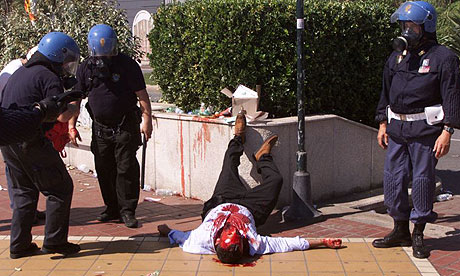
When 200,000 anti-globalisation protesters converged on the Italian city hosting the G8 summit in 2001, all but a handful came to demonstrate peacefully. Instead, many were beaten to a pulp by seemingly out-of-control riot police. But was there something more sinister at play? And will the victims ever see proper justice? Nick Davies reports
It was just before midnight when the first police officer hit Mark Covell, swiping his truncheon down on his left shoulder. Covell did his best to yell out in Italian that he was a journalist but, within seconds, he was surrounded by riot-squad officers thrashing him with their sticks. For a while, he managed to stay on his feet but then a baton blow to the knee sent him crashing to the pavement.
Lying on his face in the dark, bruised and scared, he was aware of police all around him, massing to attack the Diaz Pertini school building where 93 young demonstrators were bedding down on the floor for the night. Covell's best hope was that they would break through the chain around the front gates without paying him any more attention. If that happened, he could get up and limp across the street to the safety of the Indymedia centre, where he had spent the past three days filing reports on the G8 summit and on its violent policing.
It was at that moment that a police officer sauntered over to him and kicked him in the chest with such force that the entire lefthand side of his rib cage caved in, breaking half-a-dozen ribs whose splintered ends then shredded the membrane of his left lung. Covell, who is 5ft 8in and weighs less than eight stone, was lifted off the pavement and sent flying into the street. He heard the policeman laugh. The thought formed in Covell's mind: "I'm not going to make it."
The riot squad were still struggling with the gate, so a group of officers occupied the time by strolling over to use Covell as a football. This bout of kicking broke his left hand and damaged his spine. From somewhere behind him, Covell heard an officer shout that this was enough - "Basta! Basta!" - and he felt his body being dragged back on to the pavement.
Now, an armoured police van broke through the school gates and 150 police officers, most wearing crash helmets and carrying truncheons and shields, poured into the defenceless building. Two officers stopped to deal with Covell: one cracked him round the head with his baton; the other kicked him several times in the mouth, knocking out a dozen teeth. Covell passed out.
There are several good reasons why we should not forget what happened to Covell, then aged 33, that night in Genoa. The first is that he was only the beginning. By midnight on July 21 2001, those police officers were swarming through all four floors of the Diaz Pertini building, dispensing their special kind of discipline to its occupants, reducing the makeshift dormitories to what one officer later described as "a Mexican butcher's shop". They and their colleagues then illegally incarcerated their victims in a detention centre, which became a place of dark terror.
The second is that, seven years later, Covell and his fellow victims are still waiting for justice. On Monday, 15 police, prison guards and prison medics finally were convicted for their part in the violence - although it emerged yesterday that none of them would actually serve prison terms. In Italy, defendants don't go to jail until they have exhausted the appeals process; and in this case, the convictions and sentences will be wiped out by a statute of limitations next year. Meanwhile, the politicians who were responsible for the police, prison guards and prison medics have never had to explain themselves. Fundamental questions about why this happened remain unanswered - and they hint at the third and most important reason for remembering Genoa. This is not simply the story of law officers running riot, but of something uglier and more worrying beneath the surface.
The fact that this story can be told at all is testament to seven years of hard work, led by a dedicated and courageous public prosecutor, Emilio Zucca. Helped by Covell as well as his own staff, Zucca has gathered hundreds of witness statements and analysed 5,000 hours of video as well as thousands of photographs. Pieced together, they tell an irrefutable tale, which began to unfold as Covell lay bleeding on the ground.
The police poured into the Diaz Pertini school. Some of them were shouting "Black Bloc! We're going to kill you," but if they genuinely believed they were confronting the notorious Black Bloc of anarchists who had caused violent mayhem in parts of the city during demonstrations earlier in the day, they were mistaken. The school had been provided by the Genoa city council as a base for demonstrators who had nothing to do with the anarchists: they had even posted guards to make sure that none of them came in.
One of the first to see the riot squad bursting in was Michael Gieser, a 35-year-old Belgian economist, who subsequently described how he had just changed into his pyjamas and was queuing for the bathroom with his toothbrush in his hand when the raid began. Gieser believes in the power of dialogue and, at first, he walked towards them saying, "We need to talk." He saw the padded jackets, the riot clubs, the helmets and the bandanas concealing the policemen's faces, changed his mind and ran up the stairs to escape.
Others were slower. They were still in their sleeping bags. A group of 10 Spanish friends in the middle of the hall woke up to find themselves being battered with truncheons. They raised their hands in surrender. More officers piled in to beat their heads, cutting and bruising and breaking limbs, including the arm of a 65-year-old woman. At the side of the room, several young people were sitting at computers, sending emails home. One of them was Melanie Jonasch, a 28-year-old archaeology student from Berlin, who had volunteered to help out in the building and had not even been on a demonstration.
She still cannot remember what happened. But numerous other witnesses have described how officers set upon her, beating her head so hard with their sticks that she rapidly lost consciousness. When she fell to the ground, officers circled her, beating and kicking her limp body, banging her head against a near-by cupboard, leaving her finally in a pool of blood. Katherina Ottoway, who saw this happen, recalled: "She was trembling all over. Her eyes were open but upturned. I thought she was dying, that she could not survive this."
None of those who stayed on the ground floor escaped injury. As Zucca later put it in his prosecution report: "In the space of a few minutes, all the occupants on the ground floor had been reduced to complete helplessness, the groans of the wounded mingling with the sound of calls for an ambulance." In their fear, some victims lost control of their bowels. Then the officers of the law moved up the stairs. In the first-floor corridor they found a small group, including Gieser, still clutching his toothbrush: "Someone suggested lying down, to show there was no resistance. So I did. The police arrived and began beating us, one by one. I protected my head with my hands. I thought, 'I must survive.' People were shouting, 'Please stop.' I said the same thing ... It made me think of a pork butchery. We were being treated like animals, like pigs."
Officers broke down doors to the rooms leading off the corridors. In one, they found Dan McQuillan and Norman Blair, who had flown in from Stansted to show their support for, as McQuillan put it, "a free and equal society with people living in harmony with each other". The two Englishmen and their friend from New Zealand, Sam Buchanan, had heard the police attack on the ground floor and had tried to hide their bags and themselves under some tables in the corner of the dark room. A dozen officers broke in, caught them in a spotlight and, even as McQuillan stood up with his hands raised saying, "Take it easy, take it easy," they battered them into submission, inflicting numerous cuts and bruises and breaking McQuillan's wrist. Norman Blair recalled: "I could feel the venom and hatred from them."
Gieser was out in the corridor: "The scene around me was covered in blood, everywhere. A policeman shouted 'Basta!'. This word was like a window of hope. I understood it meant 'enough'. And yet they didn't stop. They continued with pleasure. In the end, they did stop, but it was like taking a toy away from a child, against their will."
By now, there were police officers on all four floors of the building, kicking and battering. Several victims describe a sort of system to the violence, with each officer beating each person he came across, then moving on to the next victim while his colleague moved up to continue beating the first. It seemed important that everybody must be hurt. Nicola Doherty, 26, a care worker from London, later described how her partner, Richard Moth, lay across her to protect her: "I could just hear blow after blow on his body. The police were also leaning over Rich so they could hit the parts of my body which were exposed." She tried to cover her head with her arm: they broke her wrist.
In one corridor, they ordered a group of young men and women to kneel, the easier to batter them around the head and shoulders. This was where Daniel Albrecht, a 21-year-old cello student from Berlin, had his head beaten so badly that he needed surgery to stop bleeding in his brain. Around the building, officers flipped their batons around, gripping the far end and using the right-angled handle as a hammer.
And in among this relentless violence, there were moments when the police preferred humiliation: the officer who stood spread-legged in front of a kneeling and injured woman, grabbed his groin and thrust it into her face before turning to do the same to Daniel Albrecht kneeling beside her; the officer who paused amid the beatings and took a knife to cut off hair from his victims, including Nicola Doherty; the constant shouting of insults; the officer who asked a group if they were OK and who reacted to the one who said "No" by handing out an extra beating.
A few escaped, at least for a while. Karl Boro made it up on to the roof but then made the mistake of coming back into the building, where he was treated to heavy bruising to his arms and legs, a fractured skull, and bleeding in his chest cavity. Jaraslaw Engel, from Poland, managed to use builders' scaffolding to get out of the school, but he was caught in the street by some police drivers who smashed him over the head, laid him on the ground and stood over him smoking while his blood ran out across the Tarmac.
Two of the last to be caught were a pair of German students, Lena Zuhlke, 24, and her partner Niels Martensen. They had hidden in a cleaners' cupboard on the top floor. They heard the police approaching, drumming their batons against the walls of the stairs. The cupboard door came open, Martensen was dragged out and beaten by a dozen officers standing in a semicircle around him. Zuhlke ran across the corridor and hid in the loo. Police officers saw her and followed her and dragged her out by her dreadlocks.
In the corridor, they set about her like dogs on a rabbit. She was beaten around the head then kicked from all sides on the floor, where she felt her rib cage collapsing. She was hauled up against the wall where one officer kneed her in the groin while others carried on lashing her with their batons. She slid down the wall and they hit her more on the ground: "They seemed to be enjoying themselves and, when I cried out in pain, it seemed to give them even more pleasure."
Police officers found a fire extinguisher and squirted its foam into Martensen's wounds. His partner was dragged by her hair and tossed down the stairs head-first. Eventually, they dragged Zuhlke into the ground-floor hall, where they had gathered dozens of prisoners from all over the building in a mess of blood and excrement. They threw her on top of two other people. They were not moving, and Zuhlke drowsily asked them if they were alive. They did not reply, and she lay there on her back, unable to move her right arm, unable to stop her left arm and her legs twitching, blood seeping out of her head wounds. A group of police officers walked by, and each one lifted the bandana which concealed his identity, leaned down and spat on her face.
Why would law officers behave with such contempt for the law? The simple answer may be the one which was soon being chanted outside the school building by sympathetic demonstrators who chose a word which they knew the police would understand: "Bastardi! Bastardi!" But something else was happening here - something that emerged more clearly over the next few days.
Covell and dozens of other victims of the raid were taken to the San Martino hospital, where police officers walked up and down the corridors, slapping their clubs into the palms of their hands, ordering the injured not to move around or look out of the window, keeping handcuffs on many of them and then, often with injuries still untended, shipping them across the city to join scores of others, from the Diaz school and from the street demonstrations, detained at the detention centre in the city's Bolzaneto district.
The signs of something uglier here were apparent first in superficial ways. Some officers had traditional fascist songs as ringtones on their mobile phones and talked enthusiastically about Mussolini and Pinochet. Repeatedly, they ordered prisoners to say "Viva il duce." Sometimes, they used threats to force them to sing fascist songs: "Un, due, tre. Viva Pinochet!"
The 222 people who were held at Bolzaneto were treated to a regime later described by public prosecutors as torture. On arrival, they were marked with felt-tip crosses on each cheek, and many were forced to walk between two parallel lines of officers who kicked and beat them. Most were herded into large cells, holding up to 30 people. Here, they were forced to stand for long periods, facing the wall with their hands up high and their legs spread. Those who failed to hold the position were shouted at, slapped and beaten. Mohammed Tabach has an artificial leg and, unable to hold the stress position, collapsed and was rewarded with two bursts of pepper spray in his face and, later, a particularly savage beating. Norman Blair later recalled standing like this and a guard asking him "Who is your government?" "The person before me had answered 'Polizei', so I said the same. I was afraid of being beaten."
Stefan Bauer dared to answer back: when a German-speaking guard asked where he was from, he said he was from the European Union and he had the right to go where he wanted. He was hauled out, beaten, given a face full of pepper spray, stripped naked and put under a cold shower. His clothes were taken away and he was returned to the freezing cell wearing only a flimsy hospital gown.
Shivering on the cold marble floors of the cells, the detainees were given few or no blankets, kept awake by guards, given little or no food and denied their statutory right to make phone calls and see a lawyer. They could hear crying and screaming from other cells.
Men and women with dreadlocks had their hair roughly cut off to the scalp. Marco Bistacchia was taken to an office, stripped naked, made to get down on all fours and told to bark like a dog and to shout "Viva la polizia Italiana!" He was sobbing too much to obey. An unnamed officer told the Italian newspaper La Repubblica that he had seen brother officers urinating on prisoners and beating them for refusing to sing Faccetta Nera, a Mussolini-era fascist song.
Ester Percivati, a young Turkish woman, recalled guards calling her a whore as she was marched to the toilet, where a woman officer forced her head down into the bowl and a male jeered "Nice arse! Would you like a truncheon up it?" Several women reported threats of rape, anal and vaginal.
Even the infirmary was dangerous. Richard Moth, covered in cuts and bruises after lying on top of his partner, was given stitches in his head and legs without anaesthetic - "an extremely painful and disturbing experience. I had to be held down." Prison medical staff were among those convicted of abuse on Monday.
All agree that this was not an attempt to get the detainees to talk, simply an exercise in creating fear. And it worked. In statements, prisoners later described their feeling of helplessness, of being cut off from the rest of the world in a place where there was no law and no rules. Indeed, the police forced their captives to sign statements, waiving all their legal rights. One man, David Larroquelle, testified that he refused and had three of his ribs broken. Percivati also refused and her face was slammed into the office wall, breaking her glasses and making her nose bleed.
The outside world was treated to some severely distorted accounts of all this. Lying in San Martino hospital the day after his beating, Covell came round to find his shoulder being shaken by a woman who, he understood, was from the British embassy. It was only when the man with her started taking photographs that he realised she was a reporter, from the Daily Mail. Its front page the next day ran an entirely false report describing him as having helped mastermind the riots. (Four long years later, the Mail eventually apologised and paid Covell damages for invasion of privacy.)
While his citizens were being beaten and tormented in illegal detention, spokesmen for the then prime minister, Tony Blair, declared: "The Italian police had a difficult job to do. The prime minister believes that they did that job."
The Italian police themselves fed the media with a rich diet of falsehood. Even as the bloody bodies were being carried out of the Diaz Pertini building on stretchers, police were telling reporters that the ambulances lined up in the street were nothing to do with the raid, and/or that the very obviously fresh injuries were old, and that the building had been full of violent extremists who had attacked officers.
The next day, senior officers held a press conference at which they announced that everybody in the building would be charged with aggressive resistance to arrest and conspiracy to cause destruction. In the event, the Italian courts dismissed every single attempted charge against every single person. That included Covell. Police attempts to charge him with a string of very serious offences were described by the public prosecutor, Enrico Zucca, as "grotesque".
At the same press conference, police displayed an array of what they described as weaponry. This included crowbars, hammers and nails which they themselves had taken from a builder's store next to the school; aluminium rucksack frames, which they presented as offensive weapons; 17 cameras; 13 pairs of swimming goggles; 10 pen-knives; and a bottle of sun-tan lotion. They also displayed two Molotov cocktails which, Zucca later concluded, had been found by police earlier in the day in another part of the city and planted in the Diaz Pertini building as the raid ended.
This public dishonesty was part of a wider effort to cover up what had happened. On the night of the raid, a force of 59 police entered the building opposite the Diaz Pertini, where Covell and others had been running their Indymedia centre and where, crucially, a group of lawyers had been based, gathering evidence about police attacks on the earlier demonstrations. Officers went into the lawyers' room, threatened the occupants, smashed their computers and seized hard drives. They also removed anything containing photographs or video tape.
With the courts refusing to charge the detainees, the police secured an order to deport all of them from the country, banning them from returning for five years. Thus, the witnesses were removed from the scene. Like the attempted charges, all the deportation orders were subsequently dismissed as illegal by the courts.
Zucca then fought his way through years of denial and obfuscation. In his formal report, he recorded that all the senior officers involved were denying playing any part: "Not a single official has confessed to holding a substantial command role in any aspects of the operation." One senior officer who was videoed at the scene explained that he was off duty and had just turned up to make sure his men were not being injured. Police statements were themselves changeable and contradictory, and were overwhelmingly contradicted by the evidence of victims and numerous videos: "Not a single one of the 150 officers reportedly present has provided precise information regarding an individual episode."
Without Zucca, without the robust stance of the Italian courts, without Covell's intensive work assembling video records of the Diaz raid, the police might well have evaded responsibility and secured false charges and prison sentences against scores of their victims. Apart from the Bolzaneto trial which finished on Monday, 28 other officers, some very senior, are on trial for their part in the Diaz raid. And yet, justice has been compromised.
No Italian politician has been brought to book, in spite of the strong suggestion that the police acted as though somebody had promised them impunity. One minister visited Bolzaneto while the detainees were being mistreated and apparently saw nothing or, at least, saw nothing he thought he should stop. Another, Gianfranco Fini, former national secretary of the neo-fascist MSI party and the then deputy prime minister, was - according to media reports at the time - in police headquarters. He has never been required to explain what orders he gave.
Most of the several hundred law officers involved in Diaz and Bolzaneto have escaped without any discipline or criminal charge. None has been suspended; some have been promoted. None of the officers who were tried over Bolzaneto has been charged with torture - Italian law does not recognise the offence. Some senior officers who were originally going to be charged over the Diaz raid escaped trial because Zucca was simply unable to prove that a chain of command existed. Even now, the trial of the 28 officers who have been charged is in jeopardy because the prime minister, Silvio Berlusconi, is pushing through legislation to delay all trials dealing with events that occurred before June 2002. Nobody has been charged with the violence inflicted on Covell. And as one of the victims' lawyers, Massimo Pastore, put it: "Nobody wants to listen to what this story has to say."
That is about fascism. There are plenty of rumours that the police and carabinieri and prison staff belonged to fascist groups, but no evidence to support that. Pastore argues that that misses the bigger point: "It is not just a matter of a few drunken fascists. This is mass behaviour by the police. No one said 'No.' This is a culture of fascism." At its heart, this involved what Zucca described in his report as "a situation in which every rule of law appears to have been suspended."
Fifty-two days after the attack on the Diaz school, 19 men used planes full of passengers as flying bombs and shifted the bedrock of assumptions on which western democracies had based their business. Since then, politicians who would never describe themselves as fascists have allowed the mass tapping of telephones and monitoring of emails, detention without trial, systematic torture, the calibrated drowning of detainees, unlimited house arrest and the targeted killing of suspects, while the procedure of extradition has been replaced by "extraordinary rendition". This isn't fascism with jack-booted dictators with foam on their lips. It's the pragmatism of nicely turned-out politicians. But the result looks very similar. Genoa tells us that when the state feels threatened, the rule of law can be suspended. Anywhere.
Subscribe to:
Posts (Atom)

